-
- I Replaced My Web Stack With Gopher (1991) and Failed Less
-
- ___
- |_ _|
- | |
- |___|
-
-
- ___ _ _
- | _ \ ___ _ __ | | __ _ __ ___ __| |
- | / / -_) | '_ \ | | / _` | / _| / -_) / _` |
- |_|_\ \___| | .__/ |_| \__,_| \__| \___| \__,_|
- |_|
-
- __ __
- | \/ | _ _
- | |\/| | | || |
- |_| |_| \_, |
- |__/
-
- __ __ _
- \ \ / / ___ | |__
- \ \/\/ / / -_) | '_ \
- \_/\_/ \___| |_.__/
-
-
- ___ _ _
- / __| | |_ __ _ __ | |__
- \__ \ | _| / _` | / _| | / /
- |___/ \__| \__,_| \__| |_\_\
-
-
- __ __ _ _ _
- \ \ / / (_) | |_ | |_
- \ \/\/ / | | | _| | ' \
- \_/\_/ |_| \__| |_||_|
-
-
- ___ _
- / __| ___ _ __ | |_ ___ _ _
- | (_ | / _ \ | '_ \ | ' \ / -_) | '_|
- \___| \___/ | .__/ |_||_| \___| |_|
- |_|
-
- __ _ ___ ___ _ __
- / / / | / _ \ / _ \ / | \ \
- | | | | \_, / \_, / | | | |
- | | |_| /_/ /_/ |_| | |
- \_\ /_/
-
- _
- __ _ _ _ __| |
- / _` | | ' \ / _` |
- \__,_| |_||_| \__,_|
-
-
- ___ _ _ _
- | __| __ _ (_) | | ___ __| |
- | _| / _` | | | | | / -_) / _` |
- |_| \__,_| |_| |_| \___| \__,_|
-
-
- _
- | | ___ ___ ___
- | |__ / -_) (_-< (_-<
- |____| \___| /__/ /__/
-
-
- ╔─*──*──*──*──*──*──*──*──*──*──*──*──*──*──*──*─╗
- ║1 ........................................ 1║
- ║2* ........................................ *2║
- ║3 ........................................ 3║
- ║1 ...........Posted: 2026-01-22........... 1║
- ║2* Tags: gopher haskell my_warez my_servs . *2║
- ║3 ........................................ 3║
- ║1 ........................................ 1║
- ╚────────────────────────────────────────────────╝
-
- # RFC-ish
-
- Please *DO NOT* share.
-
- If you're reading this it's because I think your opinion *particularly* matters
- when it comes to software design and/or the Gopher Protocol, or something along
- those lines.
-
- I'm looking for comments along these lines:
-
- * Spirit/abstract of this message as well as the style (the vibes and overall
- message)
- * Technical inaccuracies
- * Missing counterarguments
- * Places I'm being hand-wavy
- * Links/sources I should add
- * Alternative titles (or if you like the current, or could suggest another)* I
- Replaced Complexity with Intimacy: A Love Letter to RFC 1436
- * Scale Dazzles, Intimacy Sustains: A Formal Defense of Gopher
-
- Please submit any comments to me via:
-
- * IRC/XMPP: https://gopher.someodd.zip/services/irc.md (I'm also in the Bitreich
- IRC, but I may miss your message)
- * Email: hi@someodd.zip
- * Mastodon: @someodd@fosstodon.org[1]
- * You could even leave a comment on Phorum[2] or Interlog[3]
-
- # Intimacy in the Forgotten Stack
-
- *- Scale dazzles; intimacy sustains.*
-
- > "I find no peace, and yet I make no war; I fear, I hope, I burn, and I am ice;
- > I fly above the heavens, yet lie on the ground; And nought I have, and all the
- > world I seize on." -- *Petrarch, Canzoniere 134*
-
- *Don't worry, this isn't going to be one of those essays where a guy quotes
- Petrarch and then explains Kubernetes.* However, I feel the simple prose of
- Gopher replacing my modern software stack merits flourish.
-
- I replaced a modern web stack with a 1991 protocol and got fewer failures and
- more time to spend joyfully.
-
- A system is a love poem. Perhaps short, hopefully faithful in form: composed of
- verses that speak to each other, remembered by heart, and carried as one's own
- craft.
-
- Fidelity lives in intimacy. The romance of lovable systems lies in three
- virtues:
-
- * **Knowability**: small enough to live in your head.
- * **Composability**: its parts can be *composed like verses*, each complete,
- each
- in dialogue.
- * **Ownership**: you bear the stake, so you care.
-
-
- From these emerge resilience, clarity, and joy.
-
- My proof is **Gopher**: a 1991 protocol whose RFC you can whisper like a sonnet.
- On it I've built and self-hosted a publishing stack. I chose it because those
- three virtues endure.
-
- Some say Gopher is dead. True. So am I... *eventually*. Until then, let's serve
- menus :p
-
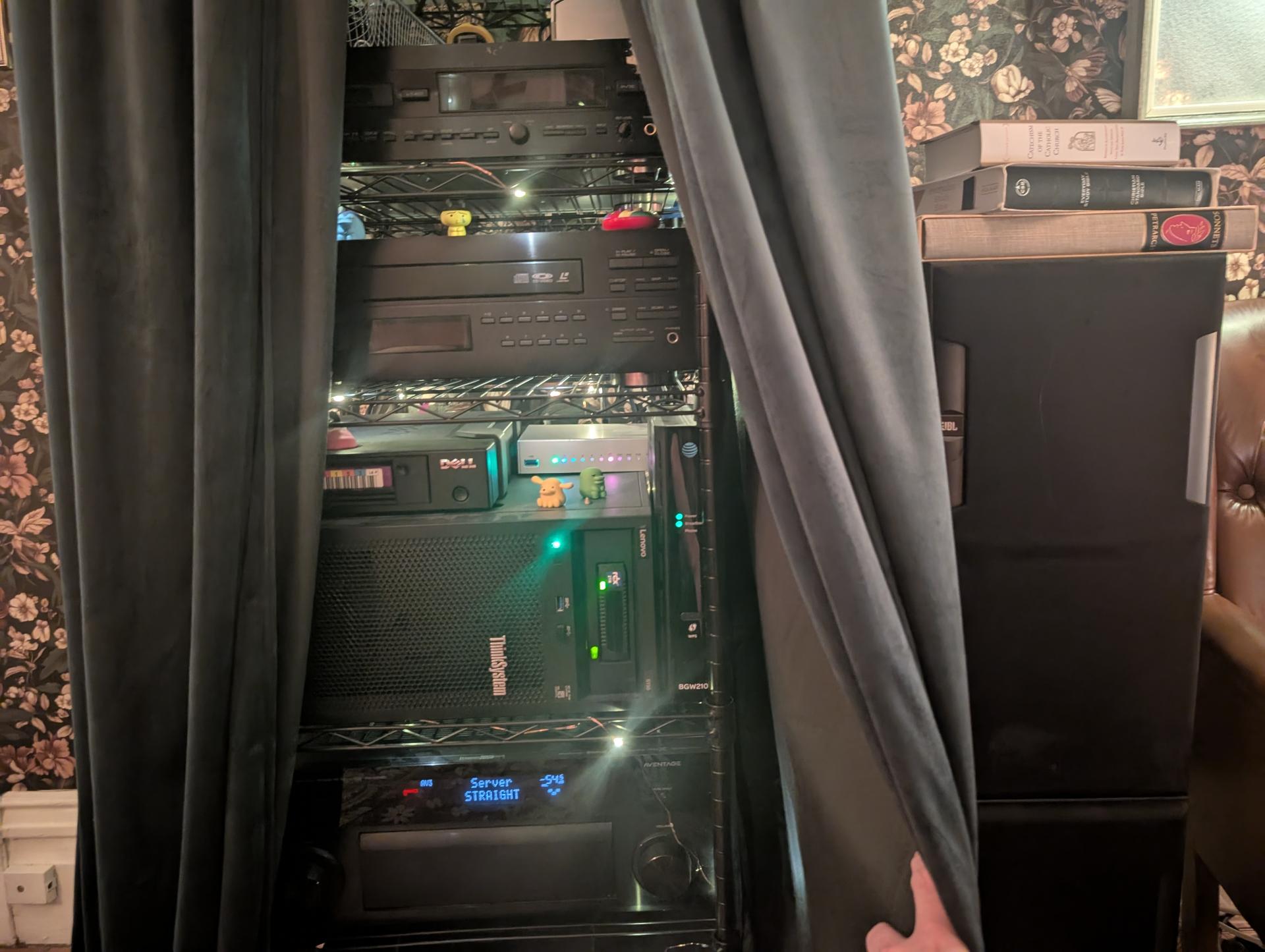
- Closeup of my server
-
- ## The Value (beyond vibes)
-
- > "Neither can embellishments of language be found without the order of thought,
- > nor thoughts shine without the light of language." -- Cicero, *De Oratore* III
- > (trans.)
-
- **Cognition**: Humans don't scale; architecture must. Compose into units one
- brain can hold. Short feedback loops cut repair time. Treat complexity as a
- budget: spend it at seams, not in guesswork. Intimacy helps individual
- understanding; shared mental models are still hard to build.
-
- **Contracts**: Interfaces are promises. State inputs, outputs, guarantees;
- version them small. When seams aren't in daylight, microservices congeal into a
- distributed monolith. Contracts alone don't create shared meaning.
-
- **Ownership**: Reliability is a who. If everyone owns it, no one does. Name a
- steward, grant authority, and keep accountability humane. Most failures begin at
- unowned handoffs. The cost is a bus factor--so intimacy needs an exit plan, for
- a new brain to rely on.
-
- **Joy**: Joy is operational. Teams maintain what they love; miserable tools get
- bypassed. Fast to hack means fast to debug and easy to teach: morale compounds
- into uptime.
-
- As an extreme case, I wrote a Gopher daemon in i386 assembly (gasm[4]): ~2 KB
- binary, ~24 KB RAM at runtime.
-
- This approach doesn't replace large-scale systems; it constrains parts of them.
- Scale isn't forbidden. Aim to keep some components small enough to reason about.
-
- I use this where it fits: edges, tools, internal services, publishing, glue.
- This thesis locates exactly where intimacy belongs: at the seams.
-
- ## A Smaller Internet Taught Me This
-
- > "Simplicity is intentional." -- *RFC 1436*
-
- *I've seen stacks with more layers than a Viennese pastry. Gopher, by contrast,
- is toast.*
-
- Most people assume the web *is* the Internet. Click a link, scroll a page,
- curtain falls; applause. But that's only one act of a much older play.
-
- Gopher was born at the University of Minnesota, 1991. Specified in RFC 1436[5],
- brief, deliberate, legible. In fact, "surfing the Internet" was coined before
- the web by Gopher's own Mark McCahill[6].
-
- Quick technical overview (see its simplicity, knowability, composability):
-
- - Send a *selector* like `/foo/bar.txt` or `Hello, world!` to the server, get
- back text/file/menu
- - Menu-driven navigation: special text the client knows how to present; each of
- its lines links to a *selector* with a letter code the client needs in order
- to understand how to present the content it links to (text/menu/file)
- - Its flourish, `IndexSearch`, simply sends a user-specified string to a
- selector, getting a menu back
- - Therefore, strict separation of navigation and content
- - The rest is up to the client, the user, that's the contract
-
- That's the whole contract. That restraint is decadent. Its simplicity is
- permissive; I made/ported games on my gopherhole[7] (having even turned ALL of
- Gopherspace into an MMORPG[8]).
-
- The Internet Gopher Protocol hides a lesson in its structure: simple, easily
- glued together, easy to master. The point is the shape of the relationships you
- can still see.
-
- Simplicity is compression for the mind.
-
- ### How I Fell In (and Stayed)
-
- > "In striving to be brief, I become obscure." -- Horace, *Ars Poetica*.
-
- I fell into Gopher by implementing the spec. I wrote a tiny client, Waffle[9],
- straight from RFC 1436[10], that experience started a journey that rewired my
- taste.
-
- Pressure-testing Gopher through heavy self-hosting[11], adjacent protocols like
- Gemini[12] (richer, but more complex), participation at Bitreich[13] (Gopher
- liminalists led by a suckless[14] trickster), and conversations with people who
- built these systems (including Gopher and first MMORPG[15] co-author Bob
- Alberti[16]) made a pattern obvious: legibility enables punk hackability.
-
- All this rewired my taste. I now bias toward protocols and tooling I can explain
- end-to-end, because that collapses debugging time and makes iteration cheap.
- Gopher is small enough that experimentation stays local--when something breaks,
- the failure surface is still human-scale.
-
- The smallness of the protocol also gave me room to experiment with
- LiquidHaskell[17] and Nix[18]. Gopher's narrow grammar, thus clarity, separated
- novelty from signal and sharpened my sense of the Unix creed: *do one thing
- well, and glue it with joy.*
-
- Constraints aren't cages; they're invitations.
-
- *Tell someone you're writing a Gopher server in 2025 and they look at you like
- you hand-weave shoelaces. Which... yes.*
-
- ## The Stack, the Masquerade
-
- > "And all things are bound together, each by its secret affinity." -- Giordano
- > Bruno, *De Vinculis in Genere* (On Bonds in General)
-
- The masquerade is choreography.
-
- It's three small daemons with narrow contracts: build, serve, search.
-
- Behind the velvet masks and candle-smoke, everyone knows their part. The music
- is simple. The rules are strict. That is why the dance holds.
-
- **Bore: the Scrivener.**[19] At the corner table, he scratches furiously with a
- quill. Every file I drop in a directory, he arranges into order: indexes, feeds,
- flourishes, prepared for gopherspace. His fidelity is quiet and absolute.
-
- **Venusia: the Confidant.**[20] From boring, quotidian tomes, to occult
- incantations of READMEs which are actually Literate Haskell Scripts[21], she
- whispers it onto the public wire. Private to published is a single breath.
-
- **Ryvm: the Librarian.** [22] Among crowded shelves kept in careful order, he
- retrieves fitting volumes according to inquiry. Technically, a full text search
- engine for the file system which is formally verified (using LiquidHaskell
- [practical here precisely because the surface area is small]): query in,
- documents out. Memory without mysticism.
-
- Together they dance: Scrivener, Confidant, Librarian. Their steps are simple,
- their composition resilient.
-
- Their secret: the masks are swappable.
-
- Bore could be Make; Venusia, gophernicus; Ryvm, `grep`.
-
- The names are mnemonic; the architecture (e.g., separable contracts) matters
- more than the cast.
-
- Keep the contracts and the choreography holds.
-
- ------------------------------
- What this makes possible (beyond Gopher):
-
- - **Dashboards** that expose system health with the same ease as serving a poem.
- - **Journaling** where each entry is an artifact, mirrored seamlessly to the
- web.
- - **Resilient hosting** on shaky Wi-Fi or tiny single-board machines -- the
- stack hums even on a gondola's bandwidth.
-
- "Why not just Markdown + S3?" Because protocol primitives shape cognition. Menus
- and selectors discipline navigation and recovery. Venusia[23] can serve static
- files *or* shell-scripted gopherapps with equal, hackable grace.
-
- Compose systems as you would compose a sonnet: strict form, infinite play.
-
- *My observability stack is called `tail -F`. Sometimes I upgrade it to
- "coffee."*
-
- ### How it feels to maintain my gopherhole
-
- On my laptop I mount `source/` over `sftp`, write a phlog in plain text with
- some frontmatter[24] and maybe a small ASCII flourish. **Save.** Bore rebuilds,
- The ryvm-searchable results appear in `output/`, which is served to gopherspace
- by Venusia, which I also have mounted. `output/` also contains non-generated
- files like media and binaries (and more text!), untouched by the build.
-
- When I want something dynamic, I write a small Literate Haskell script (or a
- longer one[25]) and configure Venusia ( `routes.toml`) to execute it via
- `runghc`. Some examples on my gopherhole[26]:
-
- * GopherGPT[27]: an LLM you can talk to via Gopher
- * Interlog[28]: an experimental phorum
- * Colossal Cave: play the original text adventure game!
-
- No ceremony, no framework gravity.
-
- I host a friend's elegant Gopher-HTTP proxy[29] I modified (which I use
- here[30]). Sometimes I mirror to the web[31]. Jekyll sweeps the artifacts to
- HTTP; a friend's proxy speaks `Gopher <-> HTTP` without drama.
-
- The fastest RCA is the one your brain can run in real time.
-
- *Most of the system's reliability comes from the fact that there isn't much of
- it.*
-
- ## Reflection: Techno-Romance, Not Neo-Luddism
-
- -- yet another tech manifesto?
-
- > "Be wise, drink free, and scale your long hopes to the short measure of time."
- > -- Horace, *Odes* I.11
-
- This is a preference for systems small enough to be held. Love is a positive
- quality, rather than a differential relation like "anti-bloat." I fell when I
- could hold it in my head. The RFC had margins. Daemons had names. The shape of
- the system was legible. Intimacy was the revelation.
-
- I stopped caring about bug counts. What mattered was how fast I could understand
- them. The hard problem is actually the limits of minds.
-
- > "Thinking of it like that, a method of easily serving directories of data,
- > **rather than a scaled down web** makes the whole thing more appealing I
- > think." -- Rob Sayers
-
- From small, stubborn tools I learned something larger than any protocol: that
- constraint *aims* creativity. That depth hides in restraint. That learning
- happens fastest when a system resists excess and invites attention. A tool you
- can know by heart teaches you how to think, not just how to deploy.
-
- There was joy in the quiet satisfaction of care. Config files that behaved.
- Systems whose quirks became familiar. That joy is a reliability feature, because
- we maintain what we understand, and we understand what we stay close to.
-
- Gopher got composted early (got this idea by interviewing Cory Doctorow for the
- documentary), returning its nutrients to the soil: clarity, patience, craft.
- What matters is choosing systems, and lives, that can be tended. To know a thing
- deeply. To care for it responsibly. To leave it better than we found it.
-
- That is enough.
-
- ## Closing invitation: Menu Walk with Me
-
- I'm turning a page, and leaving a mark here. This stack remains my way of
- publishing, my daily companion, my practice.
-
- You can explore my gopherhole[32] (try Lagrange[33] [GUI] or Bitreich's sacc[34]
- [TUI]) , open an issue on GitHub, or drop by my IRC/XMPP, or other services[35].
- I'll be there: maintaining, debugging, supporting, building.
-
- Come walk the menus. If the conversation holds, let's work together.
-
- ## Special thanks
-
- - **Bob Alberti**, for generosity, history, and play. And y'know, for his work
- on the Internet Gopher Protocol.
- - **Screwlisp**
- - **Bitreich**[36], without which this thesis and my deep love of Gopher would
- never have crystalized. Their work on bringing Gopher with into 2026 and
- beyond--and telling people why, is crucial.
- - **Norm Macdonald**, for teaching restraint, timing, and when *not* to explain
- the joke.
- - **Federico Fellini**, **Andrea Zanzotto**, **Francesco Petrarca**, and
- **Thomas Mann**, whose work shaped the voice and patience behind this essay.
- *(Zanzotto collaborated directly on* Fellini's *Casanova*; this piece
- knowingly borrows that lineage.)
- - **The MADE**, for taking small histories seriously.
- - The Gopher community and the wider smallnet/indieweb world, for keeping
- clarity alive without spectacle.
- - **Fosstodon**, for reviewing this document and for always being a well of
- support.
- - The users on my IRC and XMPP servers, who tolerate long explanations and ask
- better questions.
-
- And thank **you** for reading. At the core of all of this is a simple hope: that
- care is legible, and that someone else might recognize it and respond.
-
- ## Footnotes
-
- [1]: @someodd@fosstodon.org: https://fosstodon.org/@someodd
- [2]: Phorum: https://gopher.someodd.zip/1//phorum
- [3]: Interlog: https://gopher.someodd.zip/1//interlog
- [4]: gasm: https://github.com/someodd/gasm
- [5]: RFC 1436: https://datatracker.ietf.org/doc/html/rfc1436
- [6]: Gopher's own Mark McCahill: https://en.wikipedia.org/wiki/Mark_P._McCahill
- [7]: my gopherhole: gopher://gopher.someodd.zip
- [8]: turned ALL of Gopherspace into an MMORPG: /phlog/gopherspace-rpg.gopher.md
- [9]: Waffle: /phlog/waffle.gopher.txt
- [10]: RFC 1436: https://www.rfc-editor.org/rfc/rfc1436
- [11]: self-hosting: https://gopher.someodd.zip/1/services
- [12]: Gemini: http://geminiquickst.art/
- [13]: participation at Bitreich: /phlog/brcon-2025.gopher.txt
- [14]: suckless: https://suckless.org
- [15]: first MMORPG: /phlog/scepter_of_goth.gopher.txt
- [16]: Bob Alberti: https://albatross.org
- [17]: LiquidHaskell: https://github.com/ucsd-progsys/liquidhaskell
- [18]: Nix: https://nixos.org/
- [19]: **Bore: the Scrivener.**: https://github.com/someodd/bore
- [20]: **Venusia: the Confidant.**: https://github.com/someodd/venusia/
- [21]: READMEs which are actually Literate Haskell Scripts: https://github.com/someodd/grpg/blob/master/README.md
- [22]: **Ryvm: the Librarian.** : https://github.com/someodd/ryvm
- [23]: Venusia: https://github.com/someodd/venusia
- [24]: frontmatter: https://jekyllrb.com/docs/front-matter/
- [25]: or a longer one: /phlog/gopherspace-rpg.gopher.md
- [26]: my gopherhole: https://gopher.someodd.zip
- [27]: GopherGPT: https://gopher.someodd.zip/0//phlog/chatgopherpt.gopher.txt
- [28]: Interlog: https://github.com/someodd/interlog
- [29]: a friend's elegant Gopher-HTTP proxy: https://github.com/sternenseemann/gopher-proxy
- [30]: here: https://gopher.someodd.zip
- [31]: I mirror to the web: https://www.someodd.zip/phlog-mirror
- [32]: my gopherhole: gopher://gopher.someodd.zip/
- [33]: Lagrange: https://gmi.skyjake.fi/lagrange/
- [34]: sacc: https://packages.debian.org/sid/sacc
- [35]: my IRC/XMPP, or other services: https://gopher.someodd.zip/services/
- [36]: **Bitreich**: gopher://bitreich.org